
 01
Authoritative requirements
Identify the governing obligation, source, scope, and version applicable to the assessment.
The assessment begins with a bounded, authoritative suite of required obligations relevant to a defined industry, jurisdiction, and organizational profile—not a generic checklist or a promise to cover every rule.
Request an assessment discussionExplore page details ↓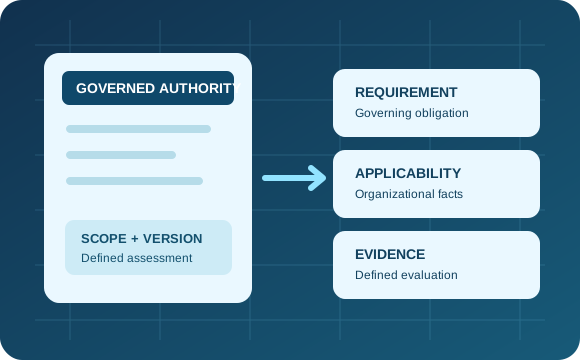
These are legal or other authoritative requirements that an organization must satisfy when the relevant applicability conditions are met. The governed assessment suite prioritizes consequential enterprise responsibilities within a defined scope; it is not an exhaustive inventory of all possible obligations.
01Identify the governing obligation, source, scope, and version applicable to the assessment.
 02
Use documented organizational facts to determine whether each requirement applies. A requirement is not waived merely because evidence is missing.
 03
Identify the evidence necessary for each applicable obligation and apply defined evaluation logic. Unsupported conclusions must not be presented as proven compliance.
Regulatory complexity remains substantive and industry-specific. I.M.P.A.C.T. relocates and governs that complexity in independently maintained obligation and evaluation resources while retaining a reusable deterministic processing architecture.
Availability is scope-dependent. A proposed industry assessment is offered only when its governed requirements, evidence model, and evaluators have been validated for the intended use. An inquiry does not imply that every vertical is currently production-ready.
Ask about assessment scope and availability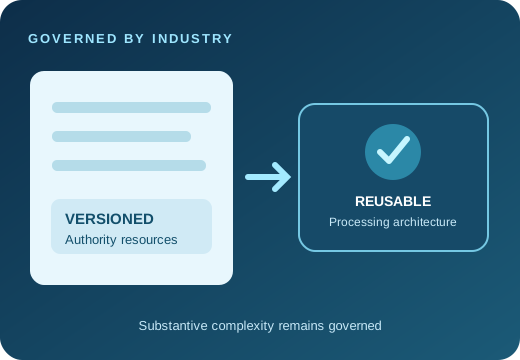
The governed suite prioritizes mandatory enterprise-level obligations for the defined industry, jurisdiction, and operating profile. Applicability is resolved separately for each obligation. Priority coverage is bounded: it is not a claim that every possible legal requirement has been assessed.

An obligation cannot be treated as satisfied simply because it appears in a checklist. Assessment depends on the requirement, documented business facts, supporting evidence, and validated evaluation logic at the specified assessment date.